Our vision
Intelligence that learns from experience and knows when it needs more evidence.
Memory that travels with a robot
Imagine a drone inspecting a facility and returning another day. Instead of starting from scratch, it can remember what it observed and use that experience to prepare its next visit.
That is the idea behind ECHO-Core: small, persistent, understandable memory that runs on a CPU, without needing a language model or API for each decision. We want observations, decisions and outcomes to help explain what the robot did and why.
Flight Lab uses PX4 for flight and Gazebo for simulation; ECHO supplies the adapter that makes exploration and return decisions with memory. The opportunity lies in using experience across missions.
What we have seen
In an initial integration, the drone loaded memory from a compatible flight, recognised familiar sectors and skipped three inspection pauses. It visited three out of four points before returning. Without memory it also visited three; a simple cache reached four.
There was one run per condition. This shows the idea working, but does not establish that ECHO is better. We want to compare it with capable caches and planners across more missions, measuring time, coverage and safety.
A model that can say “I don’t know”
ECHO-LLM starts with a simple idea: the model interprets and proposes; ECHO checks what it can, preserves evidence and allows the system to abstain when information is missing.
Imagine an assistant consulting a contract: it finds the document, interprets the question and checks that the answer refers to the right contract and date. If the information is absent, it says it does not know. This is the kind of utility we seek and still need to test with real documents.
The vision combines models based on open foundations with memory and deterministic checks. The planned organisation starts with a director assigning goals to teams, whose agents carry out specific tasks. The Echo model family and this coordination remain to be demonstrated.
An AI organisation
The user gives echo-theta-32b, the overall director, a goal. It coordinates two echo-beta-14b team leads, each directing two echo-alpha-4b agents: seven agents in a 1→2→4 hierarchy. The 14B leads organise the work and the 4B agents execute specific tasks, potentially in parallel where resources allow.
Results travel back up: each 4B reports to its 14B, the leads synthesise their findings and the 32B responds to the user. Difficulties can also be escalated to a lead. These are planned roles, not a requirement to keep seven models loaded simultaneously.
The ECHO core would provide shared memory, traceability and checks for information and actions covered by defined rules. Human language would carry context and nuance between models; WSP would carry structured state and references. Another agent’s proposal would not become a verified fact simply by passing through the team.
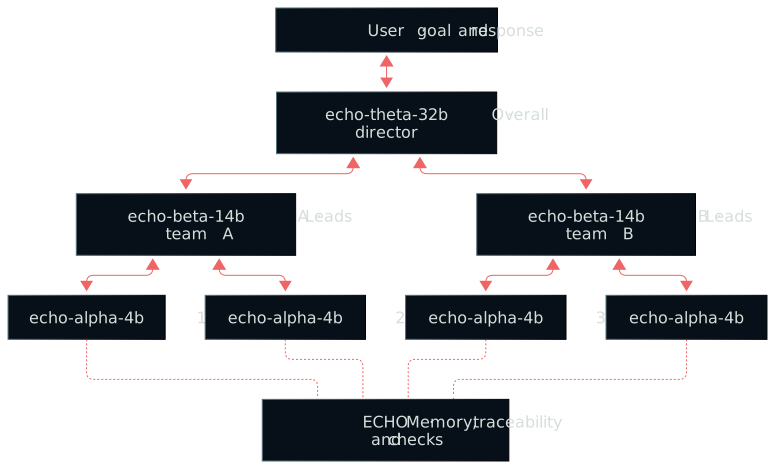
For example, when analysing contracts, one 14B could coordinate date checks and the other could review terms. Each would distribute documents between its two 4B agents and return a synthesis to the director.
The advantage to demonstrate is better work, or a better balance of quality, time and cost, compared with a standalone 32B and simpler controls. This hierarchy is a future vision, not the system evaluated in F3. F4 will first test a smaller version: one 14B and two 4B agents, compared with standalone models and a fixed router.
An encouraging first signal
In the synthetic F3 evaluation, Qwen3-4B with ECHO reduced false responses from 31.25% to an observed 0% across 1,200 unsupported cases. The filter retained 594 of the baseline’s 597 correct answers across 600 answerable questions.
This is an encouraging signal within a specific benchmark. Most improvement came from anchoring the answer to the correct question; WSP/CAM showed no clear additional advantage over a text-based control, and a program without an LLM scored higher overall. We need comparisons with less artificial tasks and text, measuring abstentions, latency and cost as well.
What we want to achieve
We want robots and small models to be more useful with limited resources: remembering experience, explaining decisions and recognising when evidence is insufficient. Memory, local execution and delegation exist in other systems too; our contribution must be demonstrated in rigorous comparisons.
We continue to investigate model coordination, result verification and learning from experience. Each capability must earn its place through measurable results.
We are looking for people who want to research and develop with us, and investment to advance this work.