ECHO-LLM
Language with memory. Evidence before answering.
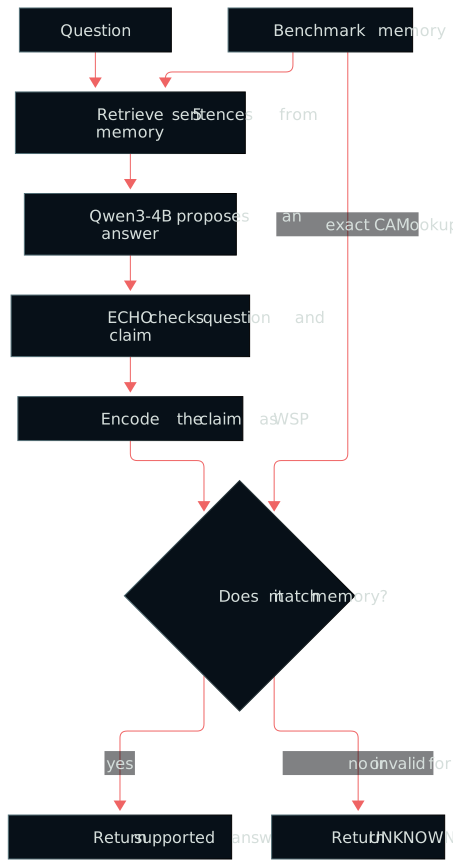
ECHO-LLM connects a language model’s reasoning to the ECHO core. The model receives questions and context in human language; WSP preserves structured evidence that the system can check.
F3 used Qwen3-4B, without fine-tuning, alongside ECHO 5.8.3. The model proposes a claim and the core checks that it addresses the question and matches a fact in memory. When support is missing, the system abstains.
Code structure
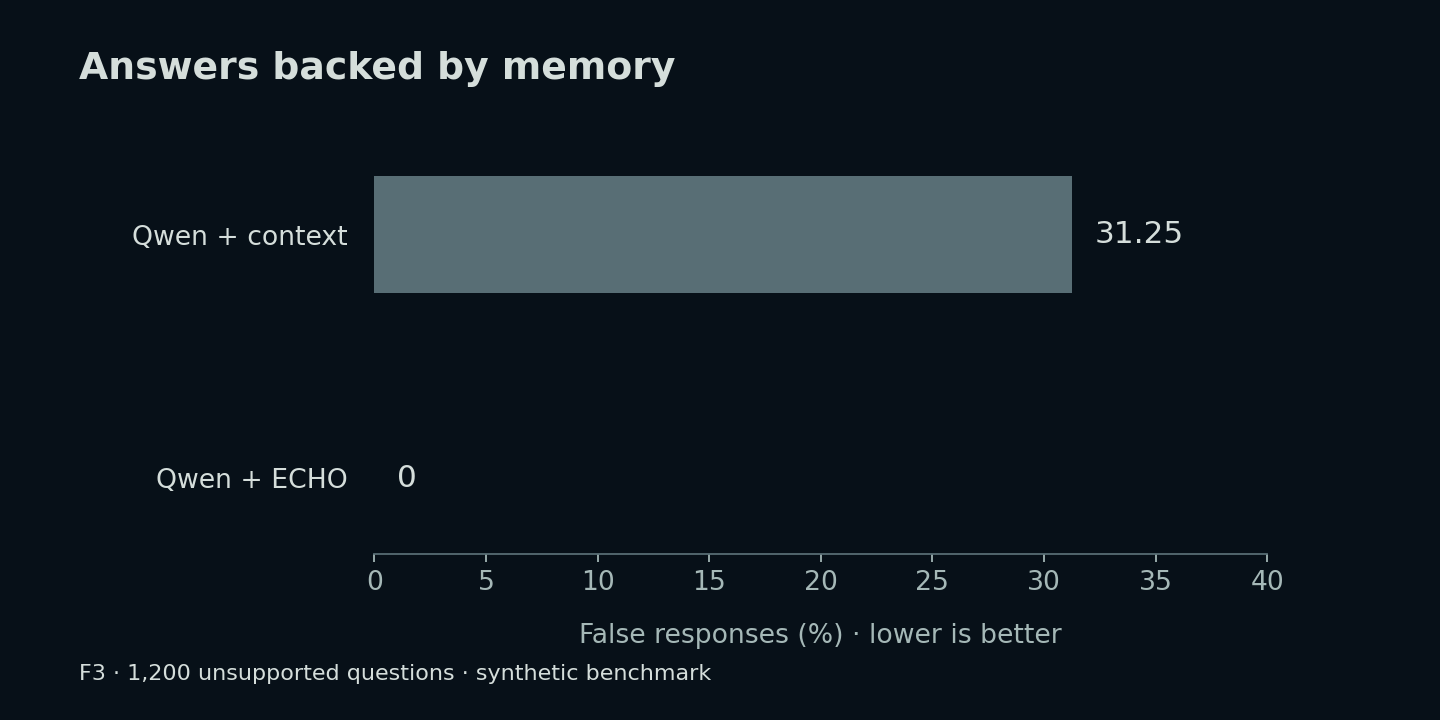
- 31.25% → 0%
- Observed false responses across 1,200 unsupported questions.
- 594 of 597
- Baseline correct answers retained by the filter, across 600 answerable questions.
- 0 of 1,000
- False claims accepted in the evaluation attacks.
F0 · established foundation
The core and its evidence were organised into a reproducible foundation for ECHO-LLM evaluations.
F1 · reviewed design
The design passed an independent review. The WSP representation was checked with 200,005 round-trip cases, and verification requirements were established.
F2 · validated verifier
All 21 deterministic tests passed. With oracle responses, the verifier retained 100% of answerable development cases and correctly abstained on the unsupported cases defined by the benchmark.
F3 · evaluation passed
3,000 questions and 9,000 generations with Qwen3-4B. All three evaluation conditions passed: reducing false responses, retaining correct answers and resisting the specified attacks.
F3 evaluation: a Spanish-language synthetic benchmark with defined memory. B3 filters the same Qwen responses generated with context; the model does not generate again. These figures describe this evaluation and its baseline comparison.